Klaviyo Alternatives for Email Sequences
Klaviyo alternatives for email sequences: why stores leave, seven ranked options, costs at 1,000, 5,000 and 10,000 profiles, and a 14-day switch plan.
Leave Klaviyo when the bill has become the problem. Its Email plan is priced on active profiles, and its help center counts every address it can email, opted in or not. The slider reads $30 a month at 1,000 profiles, $150 at 10,000 and $400 at 25,000. For a store that wants the same cart, browse, post-purchase and win-back flows on a different meter, the default move is Omnisend, which lists pre-built ecommerce workflows and a free migration service. Stay if your list is small, or if your flows lean on Klaviyo's store data and a rebuild would cost more than the monthly gap.
Every price below was read on 7 October 2026 from the vendor page linked beside it. They are list prices in US dollars, and vendors move them without notice, so check the page before you commit.
Where Klaviyo's pricing sits today
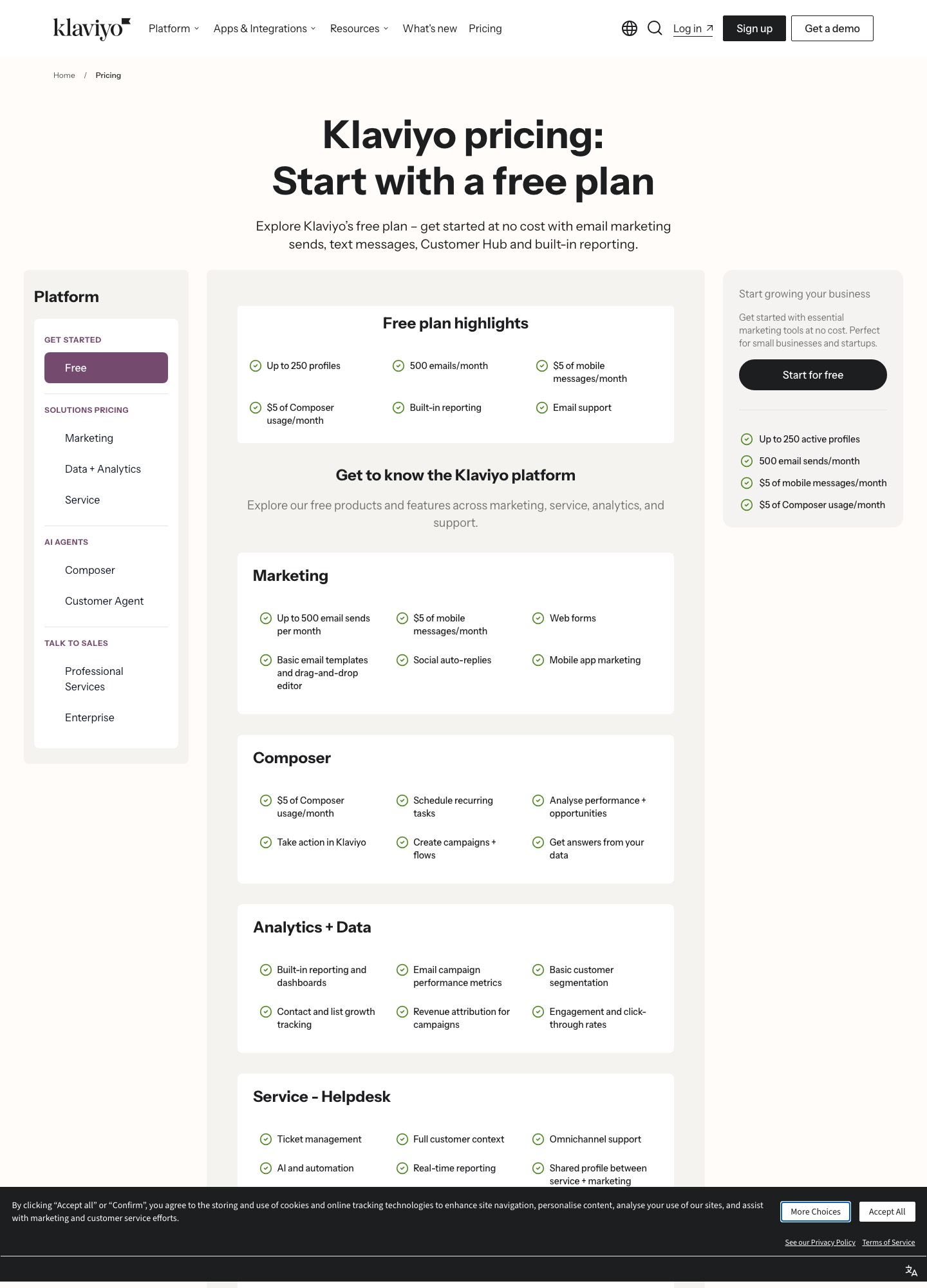
Klaviyo's pricing page sells a free plan and then an Email plan with a profile slider. Free covers up to 250 active profiles and 500 email sends a month. The paid slider reads $20 at 500 profiles with 5,000 emails a month, $30 at 1,000 with 10,000, $60 at 2,500 with 25,000, $100 at 5,000 with 50,000, $150 at 10,000 with 100,000 and $400 at 25,000 with 250,000. The page's Email+SMS selector did not render when it was read, so SMS prices are not part of this page. The rest of this page is about what happens after you decide the Email plan has stopped fitting.
Five limits in Klaviyo's own documentation that send owners shopping
- The profile count includes people who never opted in. Klaviyo's help article on active profile management says any profile that can be emailed through Klaviyo is active, and that this includes people added through general engagement, such as an address left at checkout without opting in. Only suppressed profiles drop out. In a store, that means one-time buyers who went quiet years ago keep pricing you up until you suppress them. Klaviyo suggests a sunset flow first, then a segment built from conditions such as: created at least 180 days ago, at least 5 emails received in the last 72 weeks, and no opens, clicks, site activity, product views, checkouts or orders. A bulk suppression only reaches the people in the group on the day you run it.
- The ladder steepens at the top. Divide each reading by its profile count and you get $30 / 1,000 = $0.030, $100 / 5,000 = $0.020, $150 / 10,000 = $0.015 and $400 / 25,000 = $0.016. Going from 10,000 to 25,000 profiles multiplies the list by 2.5 and the price by 400 / 150 = 2.67, so the per-profile rate stops falling. The same help article says that if you pass your profile limit you may be upgraded automatically at the next billing cycle.
- Sends are capped at ten times the profile limit. The article gives the example of a 500-profile plan allowing 5,000 emails. A store with 1,000 profiles that sends a campaign three times a week to all of them reaches 1,000 x 3 x 4 = 12,000 emails in a four-week month before a single flow email goes out, against a ceiling of 10,000. The article states the ceiling but does not describe what happens when it is passed, so ask before relying on it.
- The free plan stops instead of degrading. Klaviyo's free versus paid article says passing the profile cap blocks sending until the count falls or you upgrade, and passing the email cap blocks sending until the next month. Branding is removed only on a paid plan, and email support covers the first 60 days.
- Flows cannot leave with you. The guide to migrating off Klaviyo offers no export for flows, only draft or delete, and says deleted flows and their data cannot be recovered. That is the switching cost a price table hides: every sequence is rebuilt by hand, so the case for leaving has to beat the hours that costs.
Seven places to move store sequences, ranked for someone leaving Klaviyo
The order is fixed and written for a store leaving over cost or send limits, with cart, browse, post-purchase and win-back flows to rebuild. If your reason is different, move the entries around: someone who mainly wants a sales hand-off should start at number six.
1. Omnisend: the closest like-for-like with a different meter
Price: Omnisend's pricing page shows Free at $0 for 250 contacts and 500 emails a month. The Standard and Pro cards show first-three-month promotional rates only, $11.20 a month for Standard at 500 contacts and $41.30 for Pro, which the card pairs with 2,500 contacts, when three months are paid upfront. The text read does not state the later monthly price.
It suits stores that want store-synced flows plus SMS. The pricing grid lists pre-built workflows for cart abandonment, welcome series, post-purchase and re-engagement, unlimited custom events and automation splits on every plan. Standard sends up to 12 times the list size against Klaviyo's 10 times, and Pro lists unlimited emails under a fair-use ceiling of 60 times the list. What you lose: Omnisend bills non-subscribers who received automated messages, which is the same class of cost as Klaviyo's, SMS credits and advanced reporting sit on Pro, and an account expert starts at $400 a month. Omnisend advertises "save up to 35% vs. Klaviyo", but its Klaviyo migration page footnotes that as its own comparison of Standard against Klaviyo's email-only Marketing plan, using May 2026 rates. Treat it as a vendor claim.
2. Drip: flat bundle, unlimited sends, no free plan
Price: Drip's pricing page reads $39 a month up to 2,500 people, $89 at 5,000 people, $154 at 10,000 people and $369 at 25,000 people.
The included list names unlimited email sends, dynamic segments, onsite campaigns and up to 50 workflows, and its automation page describes 20-plus ecommerce workflow templates for welcome series, abandoned cart, abandoned browse, post-purchase and win-back. It also says revenue is traced to orders rather than opens. Against Klaviyo, in dollars a month, it is 11 below at 5,000 people (100 - 89), 4 above at 10,000 (154 - 150) and 31 below at 25,000 (400 - 369), so its argument is the unlimited sends, not a lower bill. There is no free plan, only a 14-day trial in which unlimited emails are not available. Drip's migration service covers lists above 17,500 people.
3. Sendlane: pay for emails, not profiles
Price: Sendlane's pricing page starts at $100 a month for 50,000 emails, with unlimited profiles and an overage rate it labels CPM $2.00.
Its selector asks for your average send volume excluding seasonal peaks. Take a store with 25,000 profiles that mails each of them twice a month: 25,000 x 2 = 50,000 emails, so Sendlane's page reads $100 where Klaviyo's reads $400. That is a gap of 400 - 100 = 300 a month, or 300 x 12 = 3,600 a year. The floor is the catch: the cheapest Sendlane reading is $100, against Klaviyo's $30 at 1,000 profiles, so smaller shops lose. The page lists 24/7 chat support, SMS from $0.009 per credit and a 60-day trial limited to 100 contacts and 500 sends. The page text does not list store workflow templates, so check its automation module against your cart and browse flows by name.
4. MailerLite: the lowest list price in the table
Price: MailerLite's pricing page reads Comfort $19 at 1,000 subscribers, $49 at 5,000 subscribers, $89 at 10,000 and $179 at 25,000. Power reads $39, $69, $129 and $239 at the same four stops. These are monthly prices.
Comfort sends 10 times the top of your tier each month and allows 50 active automations of up to 100 steps; Power lists unlimited automations and unlimited emails, the latter subject to a fair use policy. The free plan allows 3 active automations of 5 steps. At 10,000 subscribers Comfort is 150 - 89 = 61 a month under Klaviyo, or 61 x 12 = 732 a year, and Power is 150 - 129 = 21 a month under it. Shopify and WooCommerce integrations are listed, and the feature grid has rows for ecommerce triggers and ecommerce sales tracking, but the text read does not show which plans carry them. A store with back-in-stock, replenishment or browse flows should test each trigger by name on a trial. MailerLite states that its data storage center is in the European Union.
5. Brevo: priced by email volume, with store features held back
Price: Brevo's pricing page starts Starter at $9 a month and Standard at $18 a month for 5,000 emails a month, on monthly billing, with 10 percent off for yearly billing.
Brevo prices on the email volume you select rather than profiles, so a big list that is mailed rarely stays cheap. Standard lists unlimited multi-step workflows, web and event tracking, A/B testing and send-time optimization. The catch for a store is that "advanced ecommerce features" (AI recommendations, back-in-stock alerts and coupons) appear in the Professional card, which starts at $499 a month, and not in the Starter or Standard cards. SMS credit is sold separately. Brevo suits a shop whose sequences are welcome and win-back emails and whose list is large relative to its sends.
6. ActiveCampaign: for flows that end in a sales conversation
Price: ActiveCampaign's pricing page reads Starter $15 at 1,000 contacts, $79 at 5,000 and $149 at 10,000, and Plus $49, $145 and $189, all billed annually.
Starter caps every automation at 5 actions. If each email, wait, branch and tag counts as one, a cart sequence with two emails, a wait, a branch and a tag is already at the limit, so most stores will price Plus. Send limits are 10 times the contact limit on Starter and Plus. At 25,000 contacts Plus reads $389 a month. The saving over the 400 on the Klaviyo slider is only 400 - 389 = 11. It earns its place when a high-value order or a wholesale enquiry needs a person to follow up, because its deal pipelines and lead scoring are sold as add-ons beside the automations. For a head-to-head read Klaviyo versus ActiveCampaign.
7. Mailchimp: cheaper bands, least proof of store depth
Price: Mailchimp's pricing page lists Standard at $20 a month for 500 contacts, then $100 for the 2,501 to 5,000 band and $135 for the 5,001 to 10,000 band. Further up, the bands read $230 for 10,001 to 15,000 contacts and $310 for 20,001 to 25,000 contacts.
Those bands put Mailchimp 15 a month under Klaviyo for a 10,000-contact list (150 - 135) and 90 a month under it at 25,000 (400 - 310). Standard sends 12 times the contact count and the page shows a 50 percent first-year offer on several bands, which is a promotion rather than a list price. The free plan is 250 contacts and 500 sends a month. It ranks last because nothing on the pages read here shows its store triggers matching Klaviyo's, so run the cart and browse flows through a trial before trusting the saving.
What the same list costs at 1,000, 5,000 and 10,000 profiles
The table treats one profile, contact, subscriber or person as one email address. Billing terms differ: ActiveCampaign is billed annually, MailerLite is shown monthly, Mailchimp is the list price before promotions, and Klaviyo's page does not name a term beside the slider. Omnisend is left out of the numbers because its page read only the 500-contact selector.
| Plan | 1,000 | 5,000 | 10,000 | What the bill follows |
|---|---|---|---|---|
| Klaviyo Email | $30 | $100 | $150 | Active profiles; sends capped at 10x |
| Drip | $39 (band for 1 to 2,500) | $89 | $154 | Active people; unlimited sends at these stops |
| MailerLite Comfort | $19 | $49 | $89 | Subscribers; sends 10x the tier |
| MailerLite Power | $39 | $69 | $129 | Subscribers; unlimited sends, fair use |
| ActiveCampaign Starter | $15 | $79 | $149 | Contacts; 5 actions per automation |
| ActiveCampaign Plus | $49 | $145 | $189 | Contacts; unlimited actions |
| Mailchimp Standard | Not read | $100 | $135 | Contact band; sends 12x contacts |
| Sendlane Pro | $100 flat for 50,000 emails a month, unlimited profiles | Emails sent, not profiles | ||
In dollars a month, the gaps against Klaviyo at 5,000 profiles are MailerLite Comfort 100 - 49 = 51, ActiveCampaign Starter 100 - 79 = 21, Drip 100 - 89 = 11 and Mailchimp 0. Over a year, Comfort saves 51 x 12 = 612 at 5,000 and 61 x 12 = 732 at 10,000. At 10,000 Comfort's send room is 10 x 10,000 = 100,000 emails, the same as Klaviyo's. ActiveCampaign Starter is only 1 below Klaviyo at that size (150 - 149), Plus is 189 - 150 = 39 above it, and Drip is 4 above it.
Leaving Klaviyo: the export, the suppression file and a 14-day overlap
Klaviyo's help center splits the data into separate files, and each one matters for a different reason.
- Lists and segments. The export article says to open Audience, then Lists & segments, open the list or segment, and use Manage list or Manage segment to export a CSV, choosing all properties or a subset. Only Owner, Admin and Analyst roles can export. The file holds email, phone, standard and custom properties, the date added and channel consent details. It does not hold event data, list or segment membership, or messages received, so export each list and segment separately and name the files after them. Files stay under Settings, Other, Downloads for 30 days.
- Everyone, including non-subscribers. Klaviyo's export-all article has you build a segment of "can receive email marketing" or "cannot receive email marketing", and warns never to email it, because it includes people who never opted in.
- Suppressions. Under Audience, Profiles, Suppressed Profiles you can filter by reason and export a CSV. The suppressed profiles article lists hard bounces, more than 7 consecutive soft bounces, spam complaints and manual suppressions as reasons, and says unsubscribes and spam reports instead set an unsubscribed consent status. You therefore need the suppression file and the unsubscribed segment, two files, not one.
- Templates and reports. Templates export as HTML, and custom reports and flow analytics can be exported. History from past campaigns does not come with the contacts.
Consent is where moves go wrong. Load suppressions and unsubscribes at the destination before the subscribed file. Drip's import article says unsubscribed people from one platform are not marked unsubscribed automatically in another and asks for two separate CSV imports. Omnisend's Klaviyo migration page warns that its billing counts subscribed and non-subscribed contacts, so a large never-subscribed list can push you up a tier, and it advises cleaning before import. If you text customers, Klaviyo's migration guide recommends exporting each SMS contact's consent timestamp and phone number and keeping that file as an audit trail.
A two-week overlap that works for a store with five or six live flows:
- Day 1. Export every list, segment, the suppression file, the unsubscribed segment, templates and reports. Write down each flow's trigger, filters, delays and branches, and set none to deleted.
- Day 2. Import suppressions and unsubscribes at the new tool, then the subscribed people with their tags. Turn off any automation that the import could trigger.
- Days 3 and 4. Connect the store and authenticate the sending domain with SPF and DKIM. Omnisend's migration guide, for one, tells arrivals to redo domain authentication and warm-up and to expect a short dip in opens.
- Days 5 to 9. Rebuild in order of revenue: abandoned cart, welcome, post-purchase, browse, win-back. Leave the Klaviyo versions running.
- Days 10 to 13. Cut over one flow a day. Switch the Klaviyo flow to draft at the moment its replacement goes live, so nobody receives both.
- Day 14. Export suppressions and unsubscribes again to catch opt-outs since day 1, import them, and keep Klaviyo in draft for a further billing cycle before cancelling. Klaviyo's help center says paid usage cycles follow the billing cycle, so line up the cancellation with that date.
Our migration guide for sequence tools covers the parts that do not depend on Klaviyo, and the alternatives index lists the other incumbents.
Stay on Klaviyo if
- Your list is around 1,000 profiles. Klaviyo's $30 against MailerLite Comfort's $19 is 30 - 19 = 11 dollars a month, or 11 x 12 = 132 a year, and rebuilding eight flows will not repay that quickly.
- You are inside the 10x send ceiling. A store at 10,000 profiles sending 60,000 emails a month is using 60,000 / 100,000 = 60 percent of its room, so the cap is not what is hurting.
- You have already pruned. If suppression of dormant profiles has brought you down a step, the largest argument for leaving, the non-subscriber count, has gone.
- Your flows depend on Klaviyo's store data and SMS sits inside it. Splitting email from SMS means two tools to reconcile, and the Klaviyo flows cannot be exported.
If you are weighing one specific rival, the pages on Drip alternatives and Omnisend alternatives show where people go when they leave those two. For the sequences themselves, the welcome sequence guide for ecommerce stores is the place to start before you rebuild.
Frequently asked questions
Is Klaviyo's free plan enough to keep a store's sequences running?
Only for a very small list. The pricing page caps the free plan at 250 active profiles and 500 email sends a month, and Klaviyo's help article on free and paid plans says sending is blocked once either limit is passed, until the count drops, the month rolls over or you upgrade. The same article says free accounts carry Klaviyo branding in email footers and forms, and email support lasts 60 days after sign-up.
Does Klaviyo bill me for people who unsubscribed?
Its help center says suppressed profiles do not count toward the plan, and that with global unsubscribe switched on, which is the default, an unsubscribe suppresses the person from all future email. What does count is anyone Klaviyo can still email, including a shopper who gave an address at checkout without opting in. Checking the suppressed and non-subscribed counts before you compare prices is worth ten minutes.
Can I export my Klaviyo flows to another tool?
No export is described. Klaviyo's guide to migrating off the platform offers only two choices for flows, set them to draft or delete them, and warns that deleted flows and their data cannot be recovered. Templates can be exported as HTML, and custom reports and flow analytics can be exported, so the flow logic itself has to be rebuilt by hand in the new tool.
Which alternative is cheapest at 10,000 profiles?
On the list prices read on 7 October 2026, MailerLite Comfort at $89 a month is the lowest number in the table, against $150 on Klaviyo. It is also the plan with a send ceiling of 10 times the tier and 50 active automations, so check that your flows fit before you count the saving. Sendlane prices by emails sent instead, from $100 a month at 50,000 emails, which can win when a large list is mailed lightly.
How long does leaving Klaviyo take?
Moving the contacts is quick; rebuilding the flows is the long part. Omnisend says its free migration takes about five business days and covers up to four workflows, and a do-it-yourself move is realistically two weeks if you run the old and new flows side by side. Keep Klaviyo in draft mode for the overlap rather than deleting anything.